








Official Authority: A Statutory Record Certified by the Ontario Ministry of Education
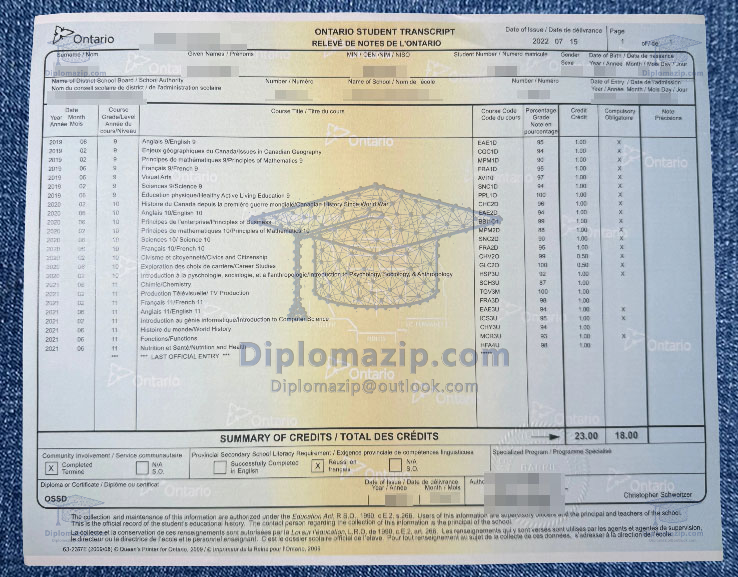
First and foremost, the authority of the Ontario Student Transcript is unquestionable. It is an official record established and maintained in accordance with the Ontario Ministry of Education’s Student Records Guide, rigorously implemented by every public school, private school, and online school within the province. The OST comprehensively documents all coursework from Grade 9 to Grade 12, including grades and credits earned for both successfully completed and unsuccessful courses.
Notably, the OST is the core component of the Ontario Student Record (OSR). Every student enrolled in an Ontario high school receives a transcript, regardless of whether they are taking credit courses. After graduation, the OSR folder (containing the OST and office index cards) is retained for 55 years, ensuring your academic record remains accessible. Ontario Student Transcript
Comprehensive Academic Record: A Holistic Assessment Beyond Grades
Unlike traditional transcripts, the Ontario Student Record comprises three core sections, embodying Canada’s educational philosophy of “whole-person development.”
Section One: Learning Skills and Habits serves as the primary component of the transcript, aligning with Canada’s educational objectives—emphasizing the cultivation of learning habits and methodologies over subject content during high school. The OSR evaluates students’ soft skills through six indicators:
- Responsibility: Demonstrates fulfillment of all learning responsibilities and commitments, including timely assignment submission
- Organization: Effectively manages time to complete tasks
- Independent Work: Completes assignments independently with minimal guidance
- Collaboration: Ability to integrate effectively into group work and respect others’ perspectives
- Initiative: Demonstrated curiosity and proactive learning attitude
- Self-Discipline: Ability to set personal learning goals and engage in constructive reflection
These six areas are not graded numerically but evaluated using four categories: E-Excellent, G-Good, S-Satisfactory, N-Needs Improvement. These skills are crucial for student development and can be reviewed in the Learning Habits section.
Part Two: Subject Grades form the core of the report card. Grades are expressed as percentages with detailed criteria:
- 80-100%: Student has mastered curriculum requirements and exceeds provincial standards
- 70-79%: Student has demonstrated solid mastery of curriculum requirements and meets standards
- 60-69%: Student demonstrates adequate mastery of curriculum requirements, approaching provincial standards
- 50-59%: Student shows limited mastery of curriculum requirements, falling below provincial standards
- Below 50%: Student exhibits significant gaps in knowledge and skills required by the curriculum
Final grades consist of 70% continuous assessment (periodic progress) and 30% end-of-term assessment (exams or summative tasks). The report card also displays the Course Median, indicating that half of all students taking the course scored at or above this mark, while the other half scored below it.
Section Three: Teacher Comments provides personalized feedback on the student’s learning progress. Effective report card comments typically include concrete examples, helping parents understand the student’s strengths and areas needing improvement.
Graduation Requirements Checklist: Comprehensive Tracking of OSSD Progress
The Ontario Transcript not only records course grades but also comprehensively tracks a student’s progress toward earning the Ontario Secondary School Diploma (OSSD). The OST clearly displays:
- Completed compulsory and elective credits
- 40 hours of community involvement documentation
- Ontario Secondary School Literacy Test (OSSLT) completion status
- Completion of online learning credits
For students transferring to Ontario from other provinces or countries, the principal will grant equivalent credits through the Prior Learning Assessment and Recognition (PLAR) process, which will be recorded on the OST. The OST is the sole official document verifying a student’s fulfillment of all graduation requirements.
Convenient Application Channels: Multiple Ways to Obtain Official Transcripts
For students who have left school, there are several convenient channels to request an Ontario transcript:
Through College Application Centers: If you are applying to an Ontario college or university, the fastest method is to apply online through the Ontario College Application Service (OCAS) or the Ontario University Application Centre (OUAC). Transcripts will be sent directly to your applied institutions. You will need to provide your Ontario Education Number (OEN) during application, which can be found on your transcript.
Contact Your Last School: If you need transcripts for employment or other purposes, contact the guidance department of the secondary school you last attended directly. Schools charge a small service fee, the exact amount of which should be confirmed with the school. Payment is typically accepted in cash, money order, or certified check.
School Closure Scenarios: If your last school has permanently closed, records are typically held at a designated receiving school. For example, after some schools in the Toronto area closed, student records were transferred to nearby schools.
Summer Applications: During the school closure period from the second week of July to the third week of August each year, many school boards offer online transcript request forms. Applications are processed within 3-5 business days after receipt of the form.
Fees and Processing Time: Reasonable charges and guaranteed turnaround
Fees for requesting Ontario transcripts are reasonable and transparent:
- Transcript: $25 CAD
- Additional Transcripts within the Same Application: $5 CAD per transcript
- Diploma (Commemorative Version): $25 CAD
Processing Time: Transcripts typically require 5-7 business days for processing. Diplomas may take up to 6 weeks due to the need to match specific diploma paper for different graduation years. This does not include mailing time. Processing times may be longer during peak periods or under certain circumstances.