








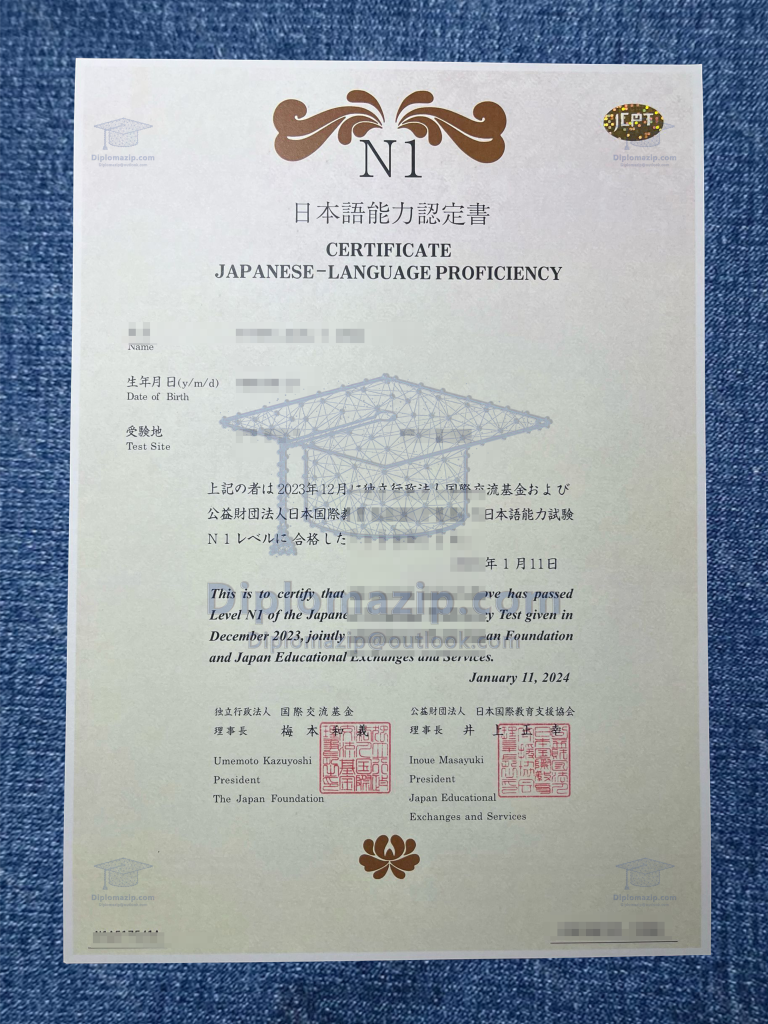
You want your JLPT N1 certificate – and you want it as quickly as humanly possible. The big question on your mind is probably: “Is there a real shortcut to getting my N1 cert without spending years on traditional study?” JLPT N1 Certificate
Here is the honest truth. The JLPT N1 certificate is an internationally recognised exam that measures your Japanese ability in reading, vocabulary, grammar and listening. There are no legitimate shortcuts or “fast-track” magic pills. However, with a laser‑focused strategy and an understanding of the official timeline, you can absolutely minimise wasted time and get certified at the earliest possible date.
🚫 “Can I Legally Get an N1 Certificate in a Few Weeks?”
Is there a shortcut to bypass the exam and get a certificate without waiting? The short answer is no – and anyone promising otherwise is selling a scam.
JLPT certificates are only issued by the Japan Foundation and Japan Educational Exchanges and Services after you pass the official exam. There is no “pay for certificate” option. Your only legitimate path is: Study hard → Pass the exam → Wait for the certificate. The good news? With the right approach, you can collapse your study timeline from years to months.
If you need a quick “plan B” certification while working toward N1, consider J.TEST (Practical Japanese Language Test) , which runs six times per year in odd‑numbered months – January, March, May, July, September and November. It focuses on practical Japanese ability and is highly regarded by Japanese companies.
⚡ “What Is the Absolute Fastest Study Strategy for N1?”
How can I master N1 vocabulary, kanji and grammar without wasting time on irrelevant material? Stop studying everything. Start studying what actually appears on the test.
80% of your exam score comes from high‑frequency words that repeatedly appear in past papers. Blindly memorising huge vocabulary lists is the #1 mistake that delays N1 success. Instead: collect all vocabulary from the last 10 years of N1 exams, sort by frequency, and prioritise words that appear 3+ times. Memorise them with their common exam‑style collocations, not just the dictionary meaning. Skip rare, obscure words – they represent less than 5% of the score.
Grammar is about context, not definitions. JLPT N1 tests your ability to distinguish between similar grammar patterns in real sentences. For example, the difference between「はずだ」and「わけだ」isn’t about their isolated meanings – it is about which situations call for which pattern. Compile every grammar question from past exams, annotate each option with its precise usage scenario, and drill the differences side‑by‑side. Do not rely on “feeling” – N1 questions are deliberately written to trick your intuition.
Reading is logic, not translation. Your goal is to map the author’s argument structure, not to translate every word. Use the “questions first” technique – read the question before the passage so you know exactly what information to hunt for. For long passages, practise scanning for transition words (しかし, つまり, なぜなら) that signal the logical flow. Time management is critical: in the actual exam, you have roughly 2 minutes per reading question on average. Practise under timed conditions.
Listening demands active exposure. The JLPT N1 listening section is fast and full of natural speech patterns. Train with NHK news and real Japanese drama dialogues. Use the “shadowing” technique – play a short clip, pause, and repeat exactly what you heard, matching the speed and intonation. Do this daily for 15‑20 minutes, and your ear will adapt faster than you expect.
📅 “How Do I Plan My Study Timeline to Hit the Next Exam Date?”
When is the next JLPT exam, and how much time do I need to prepare? The 2026 JLPT exams are scheduled for July 5 and December 6. Registration opens approximately 3 months before each exam date.
A realistic accelerated timeline for N1 looks like this:
| Phase | Duration | Daily Commitment | Key Activities |
|---|---|---|---|
| Foundation | 2‑3 months | 2‑3 hours | Master high‑frequency vocabulary, build grammar frameworks, daily listening exposure |
| Targeted Breakthrough | 1‑2 months | 2.5‑3.5 hours | Past paper analysis, weak area drilling, intensive reading speed training |
| Simulation | 1 month | 3+ hours (including full mock exams) | Timed full tests, mistake journaling, exam‑day simulation under real conditions |
If you are starting with no background, a more realistic estimate is 6‑12 months of focused study. But if you already have strong N2 or equivalent skills, you can compress the above phases into 3‑4 months with a disciplined routine.
Critical tip for speed: Take a full past paper before you start studying. Identify your exact weak points (vocabulary? grammar? listening? reading speed?). Then only study what you are missing. This targeted approach cuts your total study time by up to 50%.
🔐 “After I Pass, How Do I Get the Certificate in My Hands the Fastest?”
What is the quickest way to receive my JLPT certificate after passing? Here is the official timeline and your fastest options.
Step 1 – Check your results online immediately. For the December 2025 exam, online results were available from 10:00 AM on January 30, 2026. For future exams, expect online results approximately 4‑6 weeks after the test date.
Step 2 – Physical certificate delivery. Certificates and score reports reach local test centres about 3 months after the exam date. For example, July exam certificates typically arrive in early October, and December exam certificates in early March.
Step 3 – Choose the fastest collection method.
-
Pick up in person – This is the absolute fastest. Bring your original ID and准考证 (exam voucher). If you lost the voucher, bring a printed screenshot of your online results showing your registration number.
-
Use express courier – Many test centres offer EMS or courier delivery for an additional fee. For overseas applicants, the certificate copy application fee is approximately 50 yuan for international delivery, and you can receive it in 1‑2 weeks via courier.
-
委托代领 (Authorise a proxy) – If you cannot collect it yourself, provide your proxy with their original ID, your original ID (or certified copy), and your exam voucher. Check your test centre’s specific requirements in advance.
-
Digital certificate copies – For immediate proof while waiting, you can apply for a digital copy of your score report through the official JLPT website. This is often sufficient for employers and universities during the interim period.
💡 Pro tip: Certificates are typically kept at test centres for only 2 years. After that, they may be destroyed. Collect your certificate as soon as it arrives – do not leave it sitting there.
📌 “What Are the 2026 Rules That Could Slow Me Down?”
What are the latest JLPT policy changes I need to know before applying? Several new rules in 2026 could affect your timeline.
CEFR annotation – Starting from the December 2025 exam, all JLPT certificates include a CEFR level reference, increasing international recognition. N1 certificates now show B2 (100‑141 points) or C1 (142+ points) .
Japan test eligibility tightened – If you plan to take the exam in Japan, you now need a mid‑to‑long term residence status (在留卡) . Short‑term tourist visas are no longer accepted. The only exceptions are applicants who have already received a university acceptance letter or Japanese nationals whose native language is not Japanese. For most international students, the simplest path is to take the exam in your home country.
Potential 10‑year renewal for N1 – JLPT N1 certificates may be changed to a 10‑year renewal system in the future. The exact details are still being finalised. For now, existing certificates remain valid indefinitely.
✅ Your Action Plan for the Fastest JLPT N1 Certification
Here is your step‑by‑step checklist to get certified with minimal wasted time:
-
Take a full diagnostic past paper – identify your exact weak points before studying anything.
-
Build a compressed study plan – 2‑3 hours daily, focusing only on high‑frequency vocabulary, grammar in context, and timed reading/listening drills.
-
Apply for the next available exam – registration opens about 3 months before the July 5 or December 6 exam dates.
-
Use active recall techniques – flashcards, shadowing, and mistake journals, not passive re‑reading.
-
Check your results online – as soon as results are posted (about 4‑6 weeks after the exam), verify your score.
-
Collect your certificate immediately – either in person or via express courier. Do not wait.
-
Store your certificate safely – and consider scanning a digital copy for future use.
A JLPT N1 certificate opens doors for Japanese university admissions, employment in Japan, and career advancement. There is no magic shortcut, but with a ruthlessly efficient study strategy and a clear understanding of the official process, you can earn yours at the earliest possible date.
📍 JLPT (Japanese-Language Proficiency Test), administered by the Japan Foundation and Japan Educational Exchanges and Services, Tokyo, Japan
🔗 Official website: www.jlpt.jp