








A Comprehensive Guide to ASQ Certification: The Gold Standard for Quality Professionals Worldwide
In today’s highly competitive job market, professional certifications have become a key factor in distinguishing top talent from the average job seeker. In the field of quality management, the ASQ certification issued by the American Society for Quality is undoubtedly the most prestigious “gold standard.” Whether you are a newcomer just entering the workforce or a seasoned expert seeking a career breakthrough, ASQ certification can open entirely new doors for your professional journey. This article will provide an in-depth analysis of the value and significance of ASQ certification from multiple perspectives. ASQ Certificate
What Is ASQ Certification?
ASQ certification is a professional credential issued by the American Society for Quality (ASQ). Founded in 1946, ASQ is a global professional organization with over 60,000 members across more than 130 countries, dedicated to advancing quality management practices.
The core value of ASQ certification lies in its rigorous competency-based assessment system. Unlike ordinary training certificates, ASQ certification requires candidates to pass a comprehensive exam covering a specific Body of Knowledge to demonstrate their ability to apply quality tools and methods in real-world work scenarios. As an ANSI expert noted: “Certification differs from other types of credentials in that it is competency-based—when you determine that a person can perform a specific task, that competency is easier to measure.”
As of 2025, ASQ has issued over 550,000 certifications, and its credentials are widely recognized worldwide.
Major ASQ Certification Types and Target Audiences
ASQ offers 18 different certification tracks, covering all levels from entry-level to expert. Below are some of the most popular certifications:
1. Six Sigma Certification Series
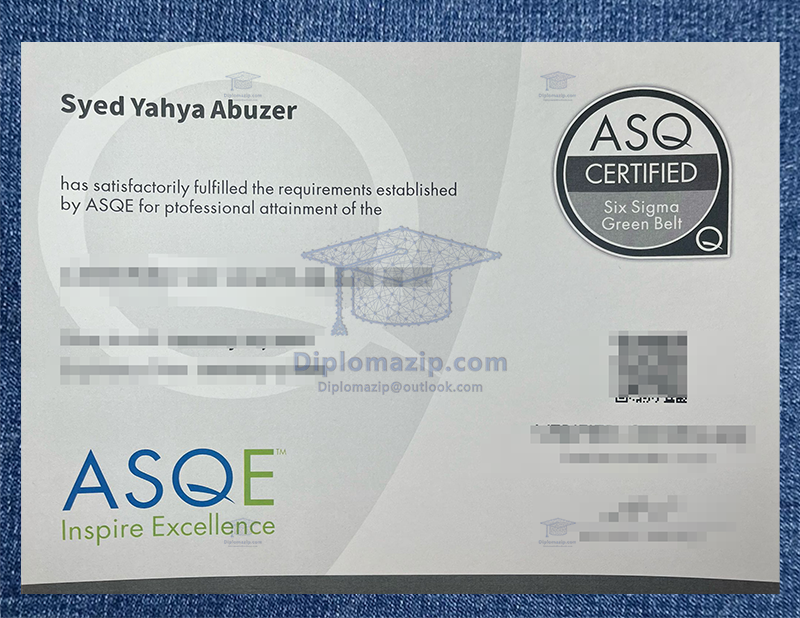
The Six Sigma certification is ASQ’s most influential product line, divided into four levels: Yellow Belt, Green Belt, Black Belt, and Master Black Belt.
- Six Sigma Yellow Belt (CSSYB): Suitable for entry-level employees or students; no work experience is required to take the exam. The certification covers Six Sigma fundamentals, Lean principles, and the DMAIC methodology. The exam fee is $422; it is an open-book exam consisting of 80 scored questions.
- Six Sigma Green Belt (CSSGB): Suitable for professionals involved in Six Sigma projects; typically requires practical project experience.
- Six Sigma Black Belt (CSSBB): Suitable for senior experts leading Six Sigma projects, responsible for cross-functional team management and continuous improvement efforts.
2. Certified Quality Engineer (CQE)
CQE is one of ASQ’s most established certifications, designed for senior professionals responsible for product quality design, development, and control. Professionals holding the CQE certification must master core skills such as statistical process control, reliability engineering, and design of experiments.
3. Certified Quality Process Analyst (CQPA)
The CQPA is positioned as a support role for quality engineers or supervisors, suitable for recent graduates or those with work experience who wish to demonstrate their ability to apply quality tools. The exam consists of 110 multiple-choice questions, lasts 4.5 hours, and costs $434.
4. Certified Quality Auditor (CQA)
The CQA specifically evaluates the compliance of quality systems and processes, requiring candidates to have 8 years of relevant work experience (including 3 years in a decision-making role). This certification has been accredited by the ANSI National Accreditation Board under the ISO 17024 standard, demonstrating its compliance with internationally recognized standards for the development and maintenance of certification programs.
5. Certified Quality Manager/Organizational Excellence (CMQ/OE)
Suitable for senior managers in leadership roles responsible for guiding organizational change and quality improvement.
Core Value of ASQ Certifications
1. Enhance Career Competitiveness and Earnings
ASQ certifications are a standout feature on a resume, significantly boosting a candidate’s professional credibility. Research indicates that professionals holding ASQ certifications generally earn higher salaries than their non-certified peers. Feedback from college graduates shows that Yellow Belt certification helps them stand out in a competitive job market, particularly in operational management and business analytics.
2. International Recognition and Professional Credibility
The value of ASQ certifications stems from their rigorous certification processes and continuous updating mechanisms. In 2022, ASQ’s five core certifications (CQA, CQE, CSSBB, CMQ/OE, CRE) received ISO 17024 accreditation from ANAB, marking a significant international endorsement of the programs’ quality. Employers and clients can trust the professional competence of certified individuals.
3. Skill Enhancement and Knowledge Update
The process of preparing for ASQ certification is, in itself, a systematic learning journey. Taking Six Sigma certification as an example, candidates must master DMAIC (Define, Measure, Analyze, Improve, Control), Lean tools (5S, Value Stream Mapping), statistical methods, and other related content. This knowledge and these skills can be directly applied in practical work.
4. Expanded Career Pathways
ASQ certification provides holders with a clear career advancement path. From Yellow Belt to Green Belt, Black Belt, and up to Black Belt Master, each level corresponds to greater responsibilities and higher compensation. Many companies require ASQ certification as a prerequisite for promotion to senior positions such as Quality Manager or Project Director.
How to Obtain ASQ Certification?
Exam Schedule and Registration Process
ASQ exams are administered in two formats: Computer-Based Testing (CBT) and Paper-Based Testing (PBT), both conducted through Prometric testing centers. Exam windows are scheduled for odd-numbered and even-numbered months; candidates must apply in advance and reserve a seat.
The registration process is as follows:
- Submit an online application (reviewed within 1–2 business days)
- Obtain an Eligibility ID upon receiving approval notification
- Log in to the Prometric website to schedule the exam
- Take the exam as required
Key Exam Policies
Open-Book Policy: All ASQ exams are open-book, but reference materials must be bound into a single volume (e.g., ring binders, spiral-bound books, etc.); hand-stapled materials are not accepted.
Score Release: Computer-based test takers receive their results immediately upon submission and will receive an official confirmation email within 3–5 business days.
Fee Policy: Fees vary by certification. For example, the CQPA fee is $434, the CQA fee is $533, and retake fees are $234 and $333, respectively.
Special Arrangements for Chinese-Speaking Candidates
ASQ offers Chinese-language paper-and-pencil exams in multiple Chinese cities, including Beijing, Shanghai, Shenzhen, Suzhou, Ningbo, Xi’an, and Chongqing. For the exam on June 13, 2026, the registration deadline is April 26. On the day of the exam, candidates must bring their original ID card and a printed admission ticket.
Study Tips and Resources
Study Resources
ASQ provides official manuals and question banks for each certification. Taking the Yellow Belt exam as an example, *Certified Six Sigma Yellow Belt* (by Govind Ramu) is the designated textbook. Candidates can also access the Body of Knowledge (BoK) document via the ASQ website to understand the exam scope and knowledge level requirements.
Preparation Tips
Students are advised to treat exam preparation as a course, studying one chapter per week for about a month. Use the official question bank for practice to familiarize yourself with question formats and the exam pace. Since the exam is open-book, it is recommended to organize labels and annotations for your reference materials in advance (you may use sticky notes as bookmarks, but they must be applied before entering the exam room).
Conclusion: Invest in Your Future, Achieve Excellence
ASQ certification is not just a certificate; it is an authoritative endorsement of professional competence. It signifies that the holder has passed a rigorous competency assessment and possesses the knowledge and skills to solve complex quality problems. For individuals, ASQ certification means higher salaries, broader career options, and a clearer career path; for organizations, hiring ASQ-certified professionals means more efficient quality management and more reliable operational outcomes.
Whether you are a student, a new professional, or a seasoned expert, ASQ offers a certification path tailored to your needs. In this era where quality is paramount, earning ASQ certification is an investment in your future—a globally recognized, lifelong professional asset.